
雅思小作文重點預測題目來啦!
雅思小作文重點預測題目來啦!十月份的考試算是近幾個月唯一沒有出現(xiàn)非數(shù)據(jù)圖表的月份。整體考情都是比較基礎(chǔ)的數(shù)據(jù)型圖表,動態(tài)和靜態(tài)各半。相信這個趨勢會延續(xù)到十一月份。就非數(shù)據(jù)圖表而言,流程圖出現(xiàn)幾率大于地圖題,下面就詳細看看吧!如需完整版PDF,戳客服即可領(lǐng)取!
1, 動態(tài)圖
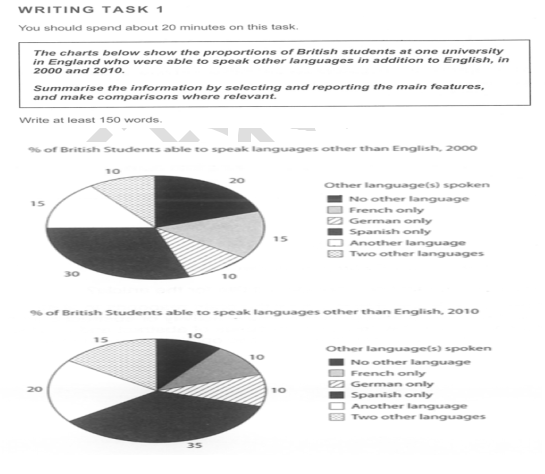
The comparison of the percentage of British students in a university in England who spoke different languages other than English is illustrated by these two pies.
In 2000, 20% of students there could not speak any other language, 5% more than those who could use French as a second language. 10 years later, the percentage of these two groups both shrank to 10%. However, the percentage of who were able to speak Germen only in addition to English remained stable at 10% in both 2000 and 2010.
Spanish was the only foreign language for 30% of students in 2000, 15% and 20% higher than who could speak another language (15%) and two other languages (10%) respectively. The proportion of all these three items increased by 5%, occupying 35%, 20% and 15% in 2010 separately.
To sum up, besides English, it is obvious that Spanish was the most popular language for those British students. Meanwhile, fewer students could not use any foreign languages, whereas more of them were able to speak 3 or 4 languages.
2, 靜態(tài)柱狀圖
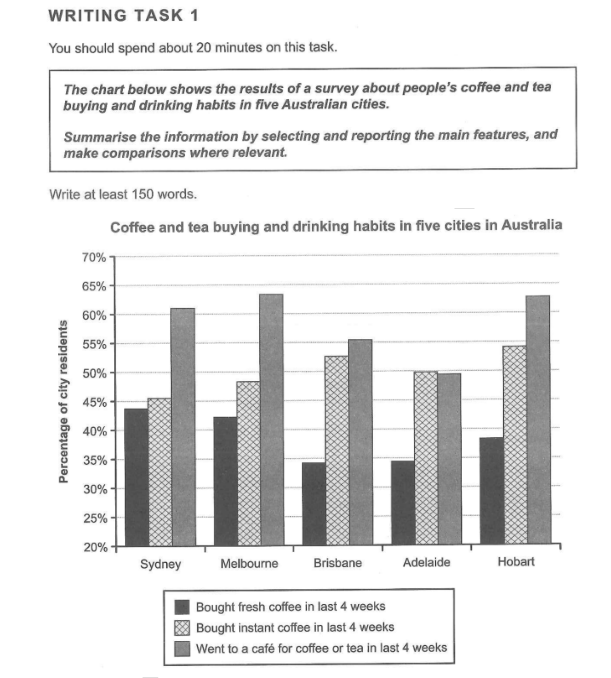
The statistics (measured as a percentage) of people’s drinking and buying habits on coffee and tea in five Australian cities from a survey is indicated by this bar chart.
To begin with, 44% residents in Sydney bought fresh coffee in last 4 weeks, a bit higher than Melbourne (43%) and Hobart (38%) respectively. Nearly 35% of people living in Adelaide did the same thing, slightly more than Brisbane (34%).
Additionally, in terms of those who bought instant coffee in last 4 weeks, figures of all five cities are higher than 45%, with Hobart accounting for the highest proportion at 54%, followed by Brisbane (53%), Adelaide (50%), Melbourne (48%) and Sydney (46%) in a decreasing order.
More interestingly, as for people who went to a café for coffee or tea in last 4 weeks, proportions of 4 cities are more than a half, with Melbourne occupying the largest percentage at 64%, Hobart 63%, Sydney 61%, and Brisbane a little more than 55%. Meanwhile, the figure of Adelaide is a slightly lower than 50%.
In summary, in 4 cities excluding Adelaide, the most popular habit is going to a café for coffee or tea since related figures are noticeably higher than the other two options. In the meantime, in Adelaide instant coffee is prevalent because almost half local people chose it during last 4 weeks. In contrast, purchasing fresh coffee is the last choice for people in all these 5 cities.
3, 流程圖
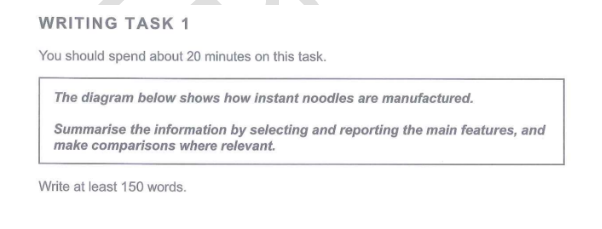
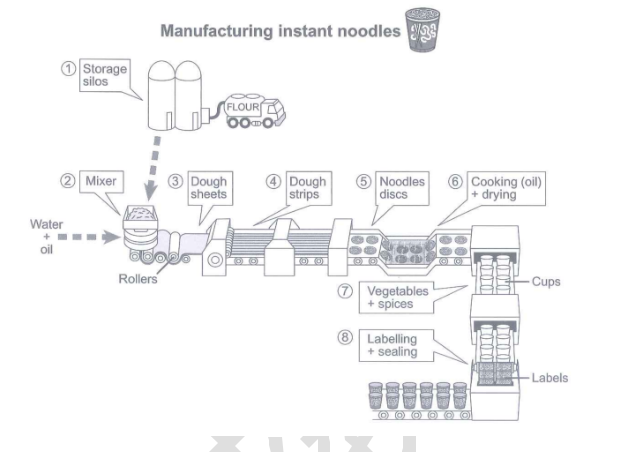
It is illustrated by this flow chart how instant noodles are produced in the production line. The whole process includes 8 clear steps.
In the first step, flour is transported to storage silos by trucks, and then it is mixed with water and oil in a mixer. Going through rollers, the mixture becomes dough sheets, which will be cut into dough strips and then processed into noodles discs over the next two steps. Thereafter, these discs are ready to be fried by cooking oil and then will be dried. In the next step, each dried disc will be put into a cup and then covered by some vegetables and spices. In the last step, those cups are labelled and sealed. Finally, the whole process is completed by those instant cup noodles being packaged.
In summary, for the production of instant noodles, flour, water, oil, vegetables, and some spices should be prepared as ingredients and seasoning. Meanwhile, after flour, oil and water is mixed, the dough will be rolled into sheets, cut into stripes, processed into discs, and deep fried. Subsequently, dried noodles discs will at last be packaged with some condiments.
猜你喜歡
-
 大陸雅思大作文解析:科研應(yīng)該由政府控制和開展2021-09-23大陸雅思大作文解析:科研應(yīng)該由政府控制和開展,這是一道觀點類大作文,討論的是科學研究是否應(yīng)該由政府控制而不是私人公司。要注【 查看詳情 】
 -

-

-
 你真的會利用雅思寫作例文嗎?聽聽雅思寫作老師怎么說!2021-10-17你真的會利用雅思寫作例文嗎?我們先來解決一個問題,是讀例文還是背例文?讀雅思例文已然成為了所有烤鴨們的必修課,這毋庸置疑。但是【 查看詳情 】



熱門閱讀
隨機閱讀